
Americas First Color Format, The 1951 Mechanical Field Sequential Spinning Color Wheel System Promoted By CBS, Morphs Into A Fully Electronic Field Sequential Color Television By JVC In 2000.
Posted September 24, 2014.
JVC TM-L450TU LCCS Video Monitor/Receiver
2000
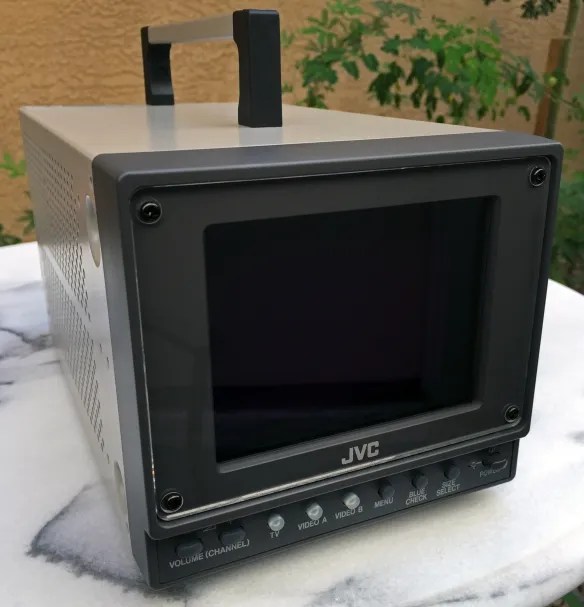
A most unique and unusual television, the JVC TM-L450TU LCCS introduced in 2000 is a modern day adaptation of the CBS field sequential, spinning color wheel television from 1951. Unlike the CBS spinning color wheel and which is also used in today’s modern DLP projection televisions, this JVC uses a unique solution, “LCCS”, which is a liquid crystal color shutter. We can say this television is a true field sequential color receiver/monitor.
The principle behind the LCCS operation is that the LCCS video monitor is a combination of the 4.5 inch black-and-white cathode ray tube and the liquid crystal color shutter which are used together to reproduce color images.
The video signal input to the monitor is demodulated into RGB primary color signals which are then stored in the field memory. Signals in the field memory are read three times faster than the input video signal is, and are displayed on the black and white cathode ray tube in the order of R, G and B. (Three images are displayed during one field) Color filters on the liquid crystal color shutter change according to the displayed primary color signal, transforming the black-and-white image into R, G and B primary color images because of the phenomenon known as persistence of vision. The R, G and B primary color images appear as a single color image to the human eye.
The benefits of LCCS are high contrast thanks to its low permeability, the liquid crystal shutter does not reflect outside light as much, enabling it to reproduce high contrast images even in direct sunlight.
The use of the black and white cathode ray tube which has no picture elements and a liquid crystal color shutter allows it to display images at high resolution.
Unlike with color cathode ray tubes, irregular color due to magnetic interference does not occur on the display because the monitor does not have any color elements.
Horizontal moire patterns (interference fringes) do not occur because the monitor does not have any color elements.
Very bright color image, no shadow mask or Arpeture Grill to block the light from the monochrome CRT.
I found this television new in an unopened factory sealed box with all its accessories. The television was sealed in its plastic wrapping and the screen had a peel-off transparent protector. The owners manual and warranty card were also sealed and unopened. The set will work with NTSC or PAL systems. The handle on top can be removed for rack mounting. It has two line video input/outputs, using BNC connectors and two line audio inputs using RCA connectors. A green LED will light when either TV, Video 1 or Video 2 are selected as well as a green LED power indicator. The built in tuner receives VHF channels 2 through 13 and UHF channels 14 through 69. The set runs on 100 volts AC – 240 volts AC or 12 volts. The set can run on the optional battery pack which attached to the rear of unit. It also has a remote input. All metal construction with a removable protective glass screen cover. The set measures 5 3/4″ W x 5 1/4″ H x 9 7/8″ D and weighs 8 lbs. The surface of the black and white CRT is set back quite deeply from the exterior viewing screen to make room for the three color filters and polarizers to fit in front of the CRT. Additional features are blue check which allows chroma and phase to be checked easily. The display size can be adjusted as OVER, UNDER and 16:9. The channels are set and selected electronically. A flip out stand is provided to adjust the viewing angle of the set. This set was manufactured April, 2000 and retailed for $1190.00. I have the service manual, parts list and schematics.
In operation, the image is like no other color image I have seen. It looks like color film. The first thing that struck me, was the smoothness of the image. There are no triad, delta color dots or pixels or RGB stripes on the screen. It’s just a continuous color image with zero separations. Barely visible are the horizontal scanning lines of the black and white 4.5 inch CRT. The color is rich and very well saturated and very accurate to my unaided eyes. The effect is smooth and natural color with excellent detail and contrast. Text is very readable, well defined and does not bloom.. The factory setting is very good and when I first turned the set on, I had no desire to adjust the factory settings. Contrast, chroma, brightness and phase can be adjusted. As you would expect, the image is very bright because there is no shadow mask or mechanism to block the light produced from the monochrome CRT. I have since reduced the brightness level to -2. I had my Sony KV 5300 Trinitron, 5 inch monitor/receiver running right next to this JVC on the same video input. The JVC and Sony have similar sized CRT’s, but it is just uncanny to view a color image with no color pixels or stripes, a very smooth, continuous color image. I prefer it to the Sony.
There is color shifting, but only from high above the diminutive screen and at an extreme angles to right or left. A cooling fan is provided and the set runs hot, not sure why. See the screen shot below which do no justice to the image quality. It is slightly over sized and I believe I can get a better quality image and will post additional screen shots.
Thinking about it, this television accomplishes what the Chromatron and Apple CRT’s set out to do and that is very bright, high resolution images that do not require convergence, perfect purity and simplicity of operation.
See the set in operation, watch the HD video here.
Watch this video in slow motion to show the switching sequential liquid crystal shutters. http://youtu.be/GTDpVZWQaFE


JVC TM-L450TU photographed September 24, 2014

Tap or click on below screen shots for full view. You will see no RGB pixels or stripes, just the horizontal scanning lines. Imagine this technology expanded to large screen CRT’s of the day.

JVC TM-L450TU Screen Shot photographed September 24, 2014

JVC TM-L450TU LCCS photographed September 26, 2014

JVC TM-L450TU LCCS photographed September 26, 2014

JVC TM-L450TU Screen Shot photographed September 24, 2014

Jvc TM-L450TU LCCS photographed September 26, 2014
Comparison screen shots of the JVC TM-L450TU on the left and Sony KV 5300 on the right. Tap or click on image for full view. Notice that #DrPhil is readable on the JVC, but on the Sony, it’s blurred and unreadable. Text on the JVC really pop with clarity.

JVC TM-L450TU and Sony KV 5300 photographed September 26, 2014.